Friday, March 12, 2021

HOMILY – Fourth Sunday of Lent – Safety Bubble

                         ____________________________________________________

Jesus is using a blind man to open our eyes to our own blindness in how we see the world and in how we see ourselves.

In a way, Jesus is bursting the safety bubble we all tend to live in – especially here in the United States.  I am forever grateful to Maryknoll for curing me of my blindness and popping my safety bubble through several years of formation and mission.     

           Remember the story years ago about the Boy who lived in the Bubble? He became known as Bubble Boy to many Americans.

Young David Vetter suffered from a severe immunodeficiency disease, requiring him to live inside a bubble, a sterile chamber where his parents could only touch him through the use of plastic gloves attached to the chamber walls. 

Bubble boy was such an intriguing news story that he was featured in a memorable 70’s movie starring John Travolta, in a popular 80s song by musician Paul Simon, and was even part of a popular episode on the TV show Seinfeld in the 90s.

            Isn’t it true that we all tend to live inside our own safety bubbles?  These are physical, psychological, and spiritual bubbles of security. Sometimes they make us blind to the problems of the world.

Jesus is here today to pop our bubbles.

For some, our safety bubble is the size of our 401K or retirement pension. For others, our safety bubble is our nice home or fancy car. For others, our safety bubble is our circle of like-minded friends or our political persuasion.

In today’s Gospel reading, Jesus performs a miracle on the man born blind. The beauty of the story is that this man comes to see the truth and then shares with others his faith in Christ Jesus, while those who might consider themselves faithful to the Law of Moses prove themselves to be blind and faithless.

As Jesus said, “I came into this world for judgment, so that those who do not see might see and those who do see might become blind.”

In Jesus’ day, blindness was seen as a curse from God’s, a sign of a person out of a right relation with God due to something they or their parents did to offend God.

His own disciples asked Jesus, “Who sinned to make this man blind?”

 Do we sometimes think the same thing of others? Are we blind to their pain, their misery, their challenges? Does our judgment of how they live their lives impact our response (those experiencing homelessness, those living on welfare, the undocumented crossing our borders)? Or has Jesus opened our eyes to see their humanity?

           Jesus is the light of the world. He wants to pop our safety bubbles, and shine a light into our souls so we might see the world through his eyes, especially see the poor and marginalized. And feel the call to enter into God's mission of love. 

            I was reminded of these bubbles we tend to live in during a Maryknoll mission immersion trip to Jamaica a few years back. For most Americans, Montego Bay, Jamaica, is a place of white sandy beaches and all-inclusive luxury resorts. This is the safety bubble most live in when visiting Jamaica.

            But this is not where the real beauty of Jamaica is found.

            We found that beauty working with a group of Korean nuns, serving in the barrios of Montego Bay, handing out bags of groceries and school supplies to those living in shacks in the poorest part of town. The smiles on the faces of the adults and children were a just glimpse at the expected smiles to be found in Heaven.

            We found that beauty spending the day with physically and intellectually disabled young people at a place called Blessed Assurance located in a mountainous area just outside town. There we experienced joy and laughter like never before.  Our presence was met with an abundance of happiness and love, as we helped these young people with their art projects, told jokes, played, and at lunchtime helped to feed those who could not feed themselves.   
     
          We found that beauty visiting a Catholic hospice where we met a man named Renville.  He fell out of a bread fruit tree years ago and was permanently confined to a bed due to a broken back. He lost the use of his lower body and has only partial use of his upper body. But Renville proceeded to share with us his own love of Jesus, a joy for living, and proclaimed a homily that would put any homily to shame.  We spoke for a long time, and at the end of our chat, he drew me in close for a big hug, and whispered in my ear, “If I get to heaven first, I’ll save you a seat for you next to me. I’ll be the first to welcome you home.”

My brothers and sisters, this is the real beauty of the Kingdom of God. This was the real beauty on our mission trip to Jamaica. Not the artificial beauty found at luxury resorts, behind locked security gates and all-you-can-eat gourmet restaurants. 

When Jesus pops our safety bubbles, we see the Kingdom clearly. And in these sacred encounters on the peripheries, we find more beauty than is found at any beach resort.

The bubbles we live in extend to how we see the world.

           Catholic blogger Elizabeth Scalia wrote on Bishop Robert Barron’s Word on Fire website, “Informationally, the world is ever-broadening, but our interests continue to shrink as we close in on ourselves. In our reading, our entertainment, our news venues, our social media, our political involvements, we seek out echo chambers we may depend upon to repeat US back to ourselves in a reassuring loop, with dissenting ideas continually pruned away for the sake of purity. Settled within virtual enclaves of the like-minded, we bask in an illusion that most sensible people think as we do, and when we are forced to venture out beyond our unsullied orthodoxies and ideologies the world feels increasingly dangerous and disordered. We cannot wait to get back to our ‘safe zones’ which are really just aspects of ourselves reflected back to US.”

            She goes on to say, “We used to read about ‘the boy in the bubble’ and feel sorry for him. He was trapped within a limited world free of exposure to even the ‘good’ germs and bacteria that keep our immune systems adept, functional, and ready to withstand and beat back infection. Now, we have become him. Though our bodies may wander freely, we keep our minds and spirits tethered to what is comfortable, unchallenging, and pristine, until our mental and spiritual immune systems become so weakened that a mere difference of opinion feels like an assault.”

          These are just a sampling of safety bubbles Jesus wants to pop in our lives.

          So, what bubble do you need Jesus to pop in your life? 

          Jesus is calling us out of our comfort zone, our echo chamber, our bubble. This is the miracle he wants to perform in our lives to cure us of our blindness. And allow us to see as he sees.


Friday, February 26, 2021

HOMILY – Second Sunday of Lent – Buen Camino

                     _______________________________________________________

One week down, five more to go on our 40-day Lenten journey.

This week’s readings focus on trust. Trust in the divine revelation of God’s covenant promise to His people and our response to it. Usually, our response is doubt and anxiety instead of belief and peace.

Life is a long journey. Sometimes we get lost along the way. Sometimes we experience doubts and anxiety about God’s promise about our destination. Many of us carry baggage of our sinfulness on this journey of life, making us weary.

Our creator and our Church want us to spend this Lent reflecting on this sinful baggage and take steps to leave it behind as we change our ways.

  In the first reading, we hear the strange story Abraham and his son Isaac. God told Abram his descendants would be as numerous as the stars. And now He is asking him to sacrifice his only son.

The Collegeville Bible Commentary sums up this passage with this insight:

“We know, as readers, that what is recounted is a test for Abraham; thus we focus on Abraham’s response and not on the horror of God’s command. We are left to imagine Abraham’s inner thoughts while the narrator tells us only what he does. We follow Abraham each step of the way as he complies with the divine command. We feel the silence as father and son walk together, coming closer with each step, to that moment of ultimate decision. We smile at Isaac’s innocent question and sympathize with Abraham in his tender but evasive answer. We watch as each detail of that final moment unfolds, from the building of the altar to Abraham’s poised knife, ready to claim his son’s life. We wait expectantly until the angel intervenes, and finally we rejoice at the turn of events. Abraham has withstood the test, and Isaac still lives.”[1]

God calls us all to be in relationship with him.

His exercise with Abraham was a test of his trust in the Lord.

Trust in God is the focus of the second reading, too. We hear St. Paul words to the Romans, “If God is for us, who can be against us?”

“The almighty power of God, who loves (human)kind to the point of handing over his Only-begotten Son to be put to death, will ensure that we emerge victorious from any kind of threat or suffering.”[2]

In essence, St. Paul is telling the Romans not to be so worried about earthly matters.

At the time, Romans were worried about real life and death issues: persecutions, betrayals, executions.  

Do we sometimes get caught up in worrying about less important earthly matters? Like, How much money is in my bank account or IRA and will it be enough for retirement? Can I buy that new car?  Will I get that promotion at work?

 Mark’s Gospel of the Transfiguration is God showing the disciples something important.

“The scene, recreated with a lot of symbolism, is magnificent. Jesus appears before them clothed in the glory of God himself. At the same time, Moses and Elijah, who according to tradition have been snatched from death and live close to God, appear in conversation with him. Everything prompts us to discern the divinity of Jesus, crucified by his enemies but raised from the dead by God.”[3]

Jesus hints at his future death and resurrection as he walks away with the disciples, but they will miss the meaning. Hopefully, we will not.

Death is such a hard topic. But we all will experience it sooner or later.

Life is a difficult journey, one fraught with pain and suffering as we carry the crosses of our own sinfulness toward our promised land.  

God wants us to let it go and return to Him with all our hearts and souls, and to love each other as we love ourselves.

I am reminded of another journey many Christians take that lasts about 40-days. The El Camino journey to Santiago de Compostela in Spain.  You may know someone who has walked the Way of St. James.

How many of you have seen the movie: “The Way?”

If you have not, and even if you have, it is a great movie to watch during Lent.  The movie is really a metaphor for life.  

It reminds us we are all on a journey. We all encounter people we do not like along the way. We all must learn to get along despite our differences. We each carry our own crosses, our own sinfulness. We all must learn to share the journey together.

God is reminding us of His covenant promise to us in all of today’s readings. God is reminding us not to be filled with anxiety and despair, but peace and hope.


God is telling us all to listen to His “chosen Son.” Are we listening?

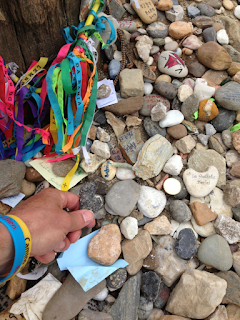
One of my favorite scenes from the movie is when the four arrive at the highest point on the Camino de Santiago, what is called “Cruz de Hierro” or the Iron Cross.

Travel guides say, “Since the 11th century… the cross has been a key feature on the Camino de Santiago. Pilgrims traditionally carry a rock with them from the start of their journey, before leaving the rock at the foot of the cross. The rock symbolizes the sins that the pilgrim has committed in life, and the act of leaving the rock is supposed to absolve them of the sins.”

Many will utter a prayer as they lay the rock on the stack of millions of rocks leading up to the cross of Jesus.

In the movie, one of the characters reads the following prayer:

“Dear Lord: May this stone, a symbol of my efforts on the pilgrimage, that I lay at the feet of the cross of the savior, weigh the balance in favor of my good deeds that day when the deeds of all my life are judged, let it be so. Amen.”

What rock of our sinfulness do we need to lay down at the cross of our Savior?

Our pride? Our judgment? Our anger? Our resentment? Our lust? Our greed?  

What sin are we working on freeing ourselves from on this 40-day Lenten journey?  

My sisters and brothers lay it down and be free. No need to carry around excess baggage on this journey we call life.

Consider spending some time in the Sacrament of Reconciliation.

Work on your relationship with our Lord and savior. Ask Jesus to help you carry your cross.

Pray daily, fast from bad habits, and do not forget to give alms to those less fortunate that you. 

This is how we walk these 40-days of Lent.

I wish you a Buen Camino, a good journey.


1 Bergant, D., & Karris, R. J. (1989). The Collegeville Bible commentary: based on the New American Bible with revised New Testament (p. 60). Collegeville, MN: Liturgical Press.

[2] The Navarre Bible: New Testament. (2008). (p. 586). Dublin; New York: Four Courts Press; Scepter Publishers.

[3] Pagola, J. A. (2011). Following in the Footsteps of Jesus: Meditations on the Gospels for Year B. (R. Luciani, Ed., V. de Souza, Trans.) (p. 49). Miami, FL: Convivium Press. 


Saturday, February 13, 2021

HOMILY – Sixth Sunday in Ordinary Time – Isolation

                        _______________________________________________________

              Mental illness is something we don’t like to talk about. Such conversations make us uncomfortable, make us uneasy.

Because we do not openly and honestly talk about depression and anxiety or other mental health issues, many of our family members and friends are suffering in isolation. Isolation that is no different than the isolation experienced by the leper in today’s Gospel.

           Jesus saw through this isolation, was moved with pity, and put his compassion into action to ease suffering.  We are called as his disciples to do the same.

           I heard a story this week about a fellow Coug alum, former Seattle Supersonic great, and now advocate for those experiencing depression and anxiety.

           James Donaldson’s story is heart-wrenching to hear.

He had it all: a 14-year successful NBA Career, an NBA All Star once, and in later years a successful physical therapy business.

           That was until he had open heart surgery in 2015, was in a coma for two weeks, and flat on his back for a year. After this life changing event, he lost his mother, he lost his marriage, and eventually, he lost his business. But not before pouring in his life savings trying to save the jobs of his 29 employees.

In the end, he lost everything, and slipped into a deep depression.

           The 7'2" former NBA star considered suicide. He first thought about hanging himself. Then he thought about attacking a police officer in hopes of dying by cop.

           He told his therapist, nobody cared about him. Nobody cares if he lives or dies.  He felt all alone and had lost all hope. 

           James Donaldson had an epiphany in 2019 following the death of WSU quarterback Tyler Hilinski. He needed to share his pain with someone, something Hilinski never felt comfortable doing.

           That is when he reached out to close friends and asked if he could call them if he needed to talk about his mental health challenges. They told him he could call at any time.  “Any time?, he asked, “Even at 2 in the morning?” His friends said, yes, even at 2 in the morning.

           James Donaldson eventually was treated by a psychiatrist who diagnosed him with acute depression and anxiety, and put him on right anti-depressant. Now Donaldson advocates for his community.

           James was suffering severe isolation. An isolation identical to the leper encountering Jesus today.   

           This is the plight of many struggling with depression and severe anxiety.

           I have received his permission to share this news with you in hopes your eyes might be opened.

Even Father Bryan has struggled with anxiety and depression over the years. Many of our priests do and have.

And I am so blessed to be one of his close friends who he can call upon any time (yes, even at 2 in the morning) when he needs to talk.

           My sisters and brothers, people struggling with mental health issues are in isolation all around us. These friends may not carry the marks of leprosy, their wounds are less noticeable. But their isolation is no less challenging. And Jesus calls us to action.

We can be just like Jesus. We can open our eyes and our hearts. We can ask questions of our friends and family members to see how they are truly doing. We can provide the ministry of presence in their times of need.

People experiencing depression and anxiety carry much shame. We can smash through that shame with these simple acts:

1. Learn about what your friend is going through

First, consider taking a Mental Health First Aid class or just learn more about depression and anxiety. This will help to better understand what is happening and how they feel.

Sometimes it is hard to know the difference between the regular ups and downs of life, and mental health issues like depression and anxiety. Some may worry about how their friends might react if they talk about it. Give them the space to talk about their feelings.

2. Be open and welcoming, and listen

It can be hard to know what to say to a depressed or anxious friend. If your friend feels like talking, ask them how they are doing.

Here’s WHAT TO SAY when someone is depressed or anxious:

Start the conversation by asking questions such as: ‘It seems like things have been hard for you lately. What’s on your mind?’ and: ‘What can I do to help?’

It might be difficult for your friend to accept your help – continue to check in with them and let them know that you care about them, and that you’re there for them if they need you.

3. Take their feelings seriously

Here’s WHAT NOT TO SAY:

If someone is experiencing depression or anxiety, it is not possible for them just to ‘snap out of it’, ‘cheer up’ or ‘forget about it’. These words ever help. 

Acknowledge that what is happening must be difficult to handle; do not tell them that their feelings are weird or unfounded.

Try to be caring, compassionate and curious, and let them know that they matter to you and you are taking them seriously.


4. Help them to find support

Your friend might not be aware of what professional support is available, or they may be unsure of how to get the support they need. Even if they know about support options, it can be daunting to see a mental health professional.

You can offer support by encouraging your friend to speak to a counselor, psychologist, or psychiatrist.

5. Continue supporting them and respond to emergencies

Whether or not your friend has decided to get professional help, it is important that they know they can get support from you, or other friends and family. Be there for them.

6. Celebrate their successes

When you are going through a tough time, it can be hard to recognize and acknowledge your own achievements. It is also hard to see your own progress and improvement.

When your friend takes a step towards confronting their fears or improving their mental wellbeing, congratulate them and do something fun together. Help them feel proud of themselves.

Jesus heals by his words and actions. You can too if you follow these simple steps.  This is how we can put our compassion into action in the name of Jesus.