Sunday, July 13, 2014

Homily – Fifteenth Sunday in Ordinary Time - The Garden of Our Soul

                                                                                                                                  Isaiah 55:10-11
Romans 8:18-23
Matthew 13:1-23


I‘m a big fan of the best-selling book called The Shack and recommend it to people who suffer a great loss in their lives. Perhaps you’ve read it. 
The story is a beautiful parable about faith, loss, great pain, and eventually healing and forgiveness through the guidance of the Holy Trinity.  It’s been called a modern retelling of the Book of Job.
The story centers on a father whose young daughter is kidnapped and brutally murdered by a serial killer while on a family vacation in the Wallowa Lake area of eastern Oregon. 
“The last trace of his daughter, a blood-stained dress, is found on the floor of a dilapidated shack set deep in the woods.  In the wake of the murder, a crushing depression settles on (the protagonist) and he (begins) to question his belief in God.  As the novel opens, (the man) receives a mysterious invitation to come to the shack.”  The man thinks the letter is penned by the killer, but it turns out the letter is sent by God.
Noted theologian Father Robert Barron also recommends the book for any Catholic who has suffered a great loss in their lives in spite of some reservations about its Protestant take on faith.
He said reading The Shack is kind of like eating a sweet, tasty watermelon.  “You got to spit out a few seeds!”
I’ve posted Fr. Barron’s thoughtful comments and recommendation on my blog.
For the purposes of this homily, I’d like to borrow The Shack author’s metaphor of the human soul as being like a beautiful garden when tended properly. 

In our lifetimes, many thorns develop in the gardens of our souls and need constant care and tending to create a thing of beauty in the eyes of God.
Some of us may think we are immune to these thorns cropping up in the gardens of our souls. But we are not.  None of us.  Not even this deacon.  And I think that’s what Jesus is telling us this weekend.  We need to keep our gardens tilled with rich, fertile soil for the word of God to continue to take root in our hearts and souls.
One thing we Catholics have to help us clean out our overgrown garden is the Sacrament of Reconciliation.  This is where we can examine closely each and every thorn bush that’s growing in our hearts and through the healing power of our savior’s love start the process of removing these thorns and tilling the soil so good seed can grow abundantly. 
I have a question for us all today.
Is our soil rich and fertile creating conditions required for the Word of God to be nurtured and come to fruition as a Disciples of Christ?
How about the soil of our children?  As Catholic adults, are we helping them to keep their soil rich and fertile so as to keep their faith fully alive and thriving? 
As some of you know, I have a new job.  On the very day Fr. Hersey returned from Guest House in Minnesota, I was asked to become the Campus Minister at Archbishop Murphy High School.  After much prayer and discernment, I accepted the job a few weeks later.
It’s been an eye-opening experience to see faith through the eyes of our teenagers.
You see, our teens pay close attention to what we say and do and are quick to point out any hypocrisy.  Especially hypocrisy to the teachings of Christ.  As parents of teens, we know how this story goes. 
Right now, our parish community is cultivating a renewal of our youth ministry.  It’s trying to create a new garden with rich, fertile soil so the Word of God can grow in the hearts of our young people.
This is so important and so vital, because so many young Catholics today walk away from faith because we fail to help them clean out their thorny gardens. 
We talk about the lessons of Jesus, but we sometimes fail to live up to Jesus’ example.  We fail to tend to our own thorny gardens and don’t see that our own hypocrisy is one of the main reasons our young people leave the faith.
Our judgments of others without showing mercy and understanding, our unkind and unloving words about our enemies, our intolerance of those we disagree with, our failure to help the least of our brothers and sisters in need, our focus on material wealth and all its trappings, all these things are enabling young people to question what this Jesus thing is all about -- what this Church is all about.
That’s why Pope Francis could not have come at a better time in our troubled world.  The Pope prefers to teach not only by his words, but more importantly by his actions. 
Ask any effective parish youth minister and you will hear the same thing, “kids are paying attention to everything Pope Francis is saying and doing.”
His appearance at last summer’s World Youth Day in Rio captivated three-point-seven million of our Catholic young people as  he called them to “make a mess” with their love of the Gospel. 
The Pope told them to make “a mess in the dioceses! I want people to go out! I want the Church to go out to the street!
I want us to defend ourselves against everything that is worldliness… that is comfortableness, that is clericalism, that is being shut-in on ourselves.  The parishes, the schools, the institutions, exist to go out!
He also told them, “Jesus, with His Cross, walks with us and takes upon Himself our fears, our problems, and our sufferings, even those which are deepest and most painful.
With the Cross, Jesus unites Himself to the silence of the victims of violence, those who can no longer cry out, especially the innocent and the defenseless.”
The Pope also did something remarkable this past week.  He said to victims of sexual child abuse gathered at the Vatican:
“I beg your forgiveness.”
He told them, “The scene where Peter sees Jesus emerge after a terrible interrogation…  Peter whose eyes meet the gaze of Jesus and weeps…  This scene comes to my mind as I look at you, and think of so many men and women, boys and girls.  I feel the gaze of Jesus and I ask for the grace to weep, the grace for the Church to weep and make reparation for her sons and daughters who betrayed their mission, who abused innocent persons.” 
Some may say, “Well, Pope Benedict did the same thing.”
Yes, he did apologize to sex abuse victims on behalf of the Church, but what ‘s remarkable about Pope Francis’ actions is the Pontiff publicly pledged himself to accountability, and not just accountability for clergy who abuse, but for bishops who cover it up.
  Powerful words on the most important crisis in our Church’s history -- what some might call the biggest thorn bush to spring up in our collective souls as Catholics.
This is why when I arrived at the campus ministry office at Murphy and noticed not a single image of Pope Francis on its walls, I immediately had numerous framed pictures made of some of the Holy Father’s most impactful teaching by example moments and put them up for all the students to see.
The lesson learned for us all can be found in a quote attributed by some to Francis’ namesake, St. Francis of Assisi: 
“Preach the Gospel always.  And if necessary use words.”
This is how we make rich, fertile soil in our souls and the souls of our children.  When there is harmony between our words and our actions and when we let our actions speak louder than our words, we create soil rich, fertile for the Word of God to take root.
If we teach the lessons of Christ, but fail to live them in our own lives, we allow thorns to grow not only in our own gardens, but the gardens of our children.
“Whoever has ears ought to hear."
At Archbishop Murphy, with the help of the students, we recently erected a Marian Grotto.  Around the Grotto and lovely statue of the Virgin Mary is a beautiful flower garden.  One of my favorite things to do daily is tend the garden, water its flowers and make sure it looks beautiful.  I suppose in a few months I’ll be tending to the weeds and thorns that may try to take root in the now rich, fertile soil.  And so it goes…


Saturday, June 7, 2014

Homily – Pentecost 2014 - The Spirit She Moves In Mysterious Ways


Acts 2:1-11

1 Corinthians 12:3b-7, 12-13

John 20:19-23


It's so funny how the Holy Spirit is at work in all our lives.
Usually in a moment of weakness, our Creator reveals Himself to us through the Holy Spirit and provides a beautiful life's lesson. 
Christ comes in amazing gift form to heal us from our broken human condition.  And it all happens through the power of the Holy Spirit that is breathed on us all at Baptism.
As my favorite rock group U2 writes,  “The Spirit… She moves in mysterious ways.”
Why “She?”  From the Old Testament, Wisdom is known as Sophia (Proverbs 8).  We refer to her now as the Holy Spirit.  And the Holy Spirit has guided the Mother Church throughout the centuries.
During our formation, the Archdiocese’s lead theologian Fr. Mike Raschko said the following:  “The Holy Spirit is a difficult topic to discuss because 'she' is very elusive. The Spirit is the one person of the Trinity that doesn't have 'form' around her.  When we think about the Father, we primarily think about the creator. We can relate to the Father as the maker of the universe. When we think about the Son, we think about the person of the Trinity that entered history to redeem us (Jesus). There is a human being with a human story to look at. When we think about the Holy Spirit, there is nothing to quickly grab onto.”
The Apostles are experiencing their first Holy Spirit moment in today’s Gospel and it transforms their lives forever. 
They’re in hiding, angry, worrying, freaked out, then Jesus walks through locked doors and says, “Peace be with you,” breaths the Holy Spirit upon them and everything changes. 
Fear and darkness are banished.   Courage and enthusiasm for the Gospel take their place.  In that moment, Christ’s Church is created.
“The Spirit… She moves in mysterious ways.”
I had a transformative Holy Spirit experience a few years back while on a trip to Europe with my family.
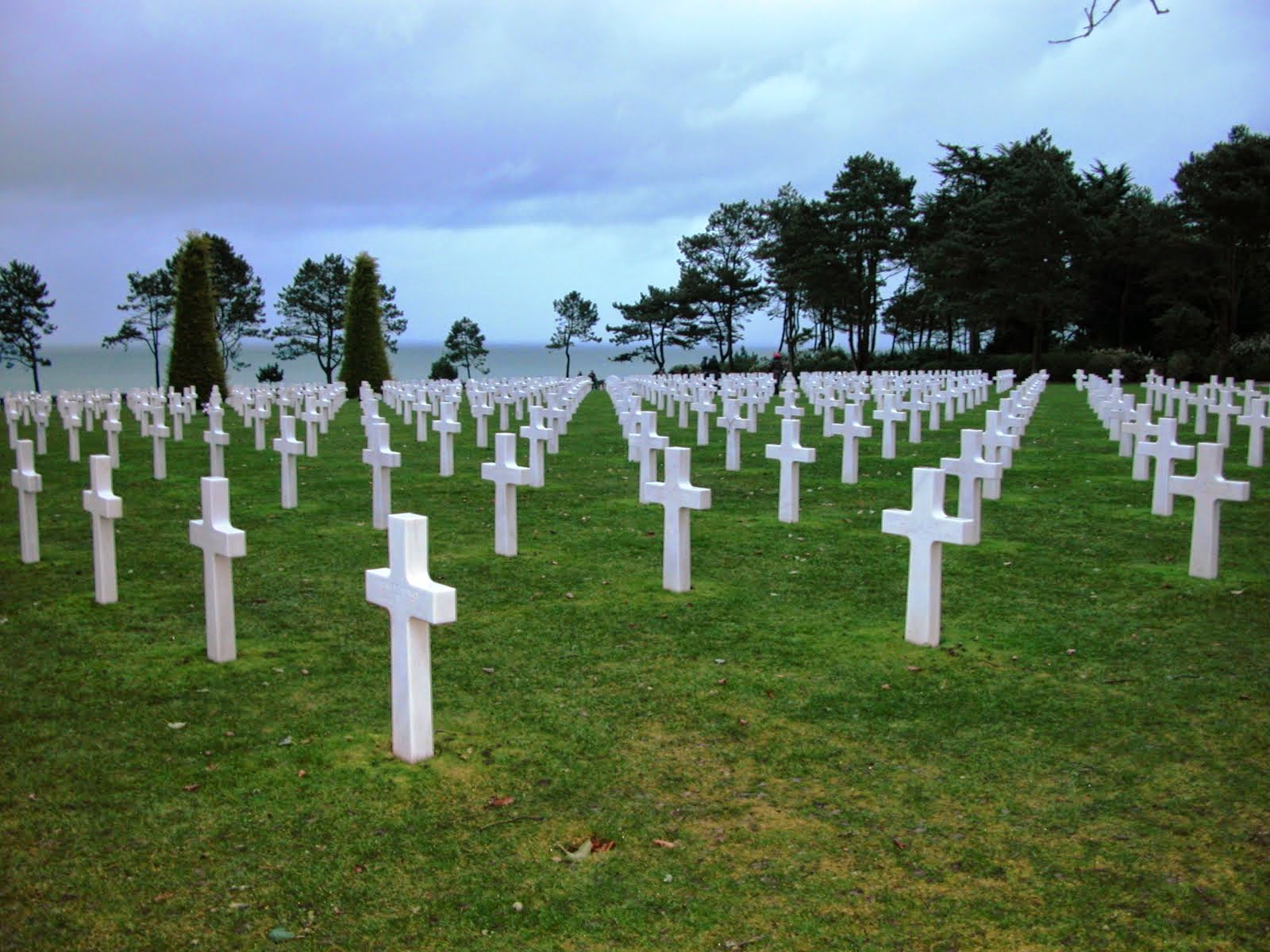
As you know, on Friday, we commemorated the 70th Anniversary of D-Day, the turning point to World War Two in Europe. 
On a cold, blustery and rainy day in December of 2011, our family traveled to Normandy Beach. 
We drove a rental car from the beautiful French village of Bayeux. Needless to say, driving in a foreign country where English is not the official language provides challenges for most Americans. When you are an impatient driver like me, the frustration gets magnified a hundredfold.
My son Connor was the navigator for the trip due to his brilliance at reading maps, and operating complicated GPS systems.
Unfortunately he took the brunt of my frustration as we tried in vain to find the Normandy American Cemetery. I was feeling lousy for letting my Irish temper get the best of me while driving through the French countryside.
Late on a dark dreary day, we finally found our destination. At first, I drove down to Omaha beach to see where the U.S. troops landed. We spent a quiet moment walking the beach as waves washed the shores where so many young men the ages of our two sons had died on June 6, 1944.
On the hillside above the beach were some German bunkers. While Sean and Connor were crawling around these dens of death and destruction, I walked up the hillside alone and noticed that the cemetery was just a little further up the path.
Saving Private Ryan is a favorite movie. Like most people, I cry every time James Francis Ryan walks through the cemetery as an old man filled with all those painful memories.
As I prepared for what I was about to experience, I prayed a decade of the rosary for all those young lives cut short on that fateful and important day in our history. I also prayed my family would forgive me for losing my cool while driving there.

I was by myself as the rows and rows of crosses appeared after rounding a corner.  Emotions swelled.  A tear ran down my cheek.
Just then, a guy walked up and asked, "Are you an American?" I said, "Yes," and he introduced himself as "Andy" and started showing me around the cemetery.
He told me not all of the graves were for servicemen. Three women are buried at the cemetery, mostly servicewomen nurses and Red Cross workers.
He asked what I did. I told him I was in formation to become a deacon in the Catholic Church. He then showed me the graves of four chaplains who died on the beach that day.  Andy said chaplains had one of the most dangerous jobs in the Normandy invasion due to their low numbers and high death rate.

I asked Andy what he did at the Cemetery. He said nonchalantly, "I'm the Director."
Just then my family showed up. I introduced everyone to Dwight "Andy" Anderson, Director of the Normandy American Cemetery.

Then he showed us the graves of the brothers who inspired the movie Saving Private Ryan:  Preston and Robert Niland. He told us the movie embellished some of the details, but basically got much of the story right.
Two brothers were killed during the invasion, one on Omaha beach, the other on Utah beach. A third brother Edward was a prisoner of war in a Japanese camp in the Pacific at the time of the Normandy invasion. The fourth brother Frederick "Fritz" Niland eventually was returned home. He's the one the movie was about.
After spending a long time showing us the outdoor stone chapel and other important grave markers, he asked our family if we would join a few other Americans on site that day to take down the American Flag for the night. We said, "We'd be honored."
My wife Mary offered to video the experience on my iPhone. Oldest son Sean took photographs. Connor and I joined the ranks as the lowering of colors service began.
As the flag touched our fingers and we began to fold it, the skies opened up in a torrential downpour. It was almost as if heaven was sending down tears on this solemn moment.
Just as the rain soaked us on that cold December day, the Holy Spirit is drenching the disciples at the feast of Pentecost, pouring over them and changing them forever.
“The Spirit… She moves in mysterious ways.”
The quiet whisper of God in our special moment plays loudly and clearly in my mind now:  When you're lost, when you’re frustrated, when you’re angry, when you’re freaked out, trust in God, and God alone, to get you through it. Allow the Holy Spirit to pour down on you and everything will be alright.
My exasperation with driving, getting lost, backtracking, double-backtracking, was all part of God's plan to make sure our family experienced something remarkable at Normandy.
Had we not gotten lost, we would have never received a beautiful gift from God.  We would have missed a divine moment when heaven and earth intersected, but for a brief moment. 
Jesus reminds his disciples this weekend his peace is with them always.  Trust Christ’s peace in your life.
As we experience Pentecost, I encourage you to let the Holy Spirit soak you with Christ’s goodness.  Let it permeate your very being.  Let is transform you in ways that will heal your troubled soul. 
Allow the Spirit to move in mysterious ways in your life. 
May the peace of Pentecost be with you always.
 

Homily - AMHS Baccalaureate


Acts 22:30;23:6-11

1 Timothy 6:17-19

John 17:20-26


Well, you made it.  But the journey doesn’t end here.
Actually, as Disciples of Christ, our journey never ends until we enter the Kingdom.  But our journey through this life requires several things: courage, commitment and perseverance.  Being disciples of Christ is never easy. 

In today’s first reading, the only apostle prophetically called by Jesus to discipleship, St. Paul, is thinking, maybe this is it.  Maybe my journey will end right here and now in Jerusalem before these angry, blood-thirsty men. 
Even his captors fear for his life as a fight ensues over Paul’s radical devotion to Jesus Christ. Because his whole experience with Christ flies in the faces of Sadducee beliefs, they were ready to tear him apart.
But Jesus gives Paul the comforting, or maybe not so comforting, words;
”Take courage.  For just as you have borne witness to my cause in Jerusalem, so you must also bear witness in Rome.”
Rome is where his journey will end as he’s beheaded and made a martyr after many years of spreading the Gospel throughout the Mediterranean.  Paul was the model of courage, commitment and perseverance.
Mirroring St. Paul’s experiences is today’s saint.  It’s the Memorial Day for St. Boniface, Bishop and martyr. 

He could have stayed put in his comfy 8th Century monastery in England, but instead wanted to be a missionary and share the Gospel with the pagans in the wilds of Western Europe. 
Some experts say, St. Boniface willed himself to be a martyr.  He wanted to die for his faith.  Pretty intense, huh?  St. Boniface was a model of courage, commitment and perseverance.
In today’s Gospel, Jesus is praying for all of His followers throughout the centuries, especially those who will face hardships.  That includes you.  Jesus is praying for you, too.
In some of his most important prayers to His Father before His crucifixion, Jesus is praying for all future believers.  Jesus is praying for unity among his believers.  Jesus is triumphantly drawing all of us to His embrace.
But are we open to that embrace?  Do we want to face hardship?  Or in our privileged lives as Americans, have we become numb to Christ’s love? 
 
As our own Archbishop J. Peter Sartain puts it, “You were made for God.  God loves you.  God forgives you.  God is extending a hand of friendship to you.  God has a plan for you.  God is patient with you.  God will never abandon you.  God wants you to be with him forever.”
Just know, wherever you are on your faith journey, Jesus is praying for you.  And Jesus is ready to welcome you into his loving embrace.  
May God bless each and every one of you.  We’ll be praying for you, too.