Saturday, March 8, 2014

Homily – First Sunday of Lent - Will we pass the test?


Genesis 2:7-9;3:1-7
Romans 5:12-19
Matthew 4:1-11

I have a reoccurring dream.  I’m back in school and it’s test day.  But I am not ready.  I failed to study.  I’m unprepared. 

Panic.  Distress.  Terror.  All these feelings overwhelm me.

To add insult to injury -- and I apologize in advance for planting this image in your brain-- but I’ve showed up for my test wearing only my underwear.  No clothes at all. 

And I’m trying desperately to hide before anyone notices a fellow student traipsing around clad only in his skivvies.

Now, my feelings are amplified with embarrassment and shame.

I am always so relieved when I wake up from this horrible, horrible nightmare. 

I’ve been told by many they’ve had similar anxiety dreams. 

Not sure what it all means. It’d probably take some serious couch time with a psychologist for me to understand its origins.

Maybe it comes from a deep, dark place in our collective memory. Maybe it’s rooted in humanity’s subconscious; planted there by our experiences in the garden with our creator and our shame for failing the test.

We are all on our Lenten journey.

On Ash Wednesday, we were reminded that we are dust, and to dust we shall return.  We were asked to repent and believe in the Gospel.

In essence, we are being told to WAKE UP!

Wake up to what we’re doing wrong in our lives.  Wake up to our own sinfulness.  Wake up to the things that distance us from God, the things we do we don’t want God to see, the things we do in our lives that bring us shame.

Shame is such a strong emotion. When we let down God, when we sin, we experience shame, regret, embarrassment and sorrow.

Sometimes, to escape these feelings, we like to convince ourselves a sin is not a sin.  It’s a game we play with ourselves. 

We try to be smarter than God. 

We are tempted and fail the test, over and over again.  After all, we’re only human.

Thank God for the Lenten season. Thank God for these 40 days to focus on getting it right in God’s eyes.


20th Century Catholic mystic and writer Thomas Merton once said, “Lent is not just a time for squaring conscious accounts, but for realizing what we had perhaps not seen before.  The light of Lent is given us to help us with this realization.”

Pope Francis calls Lent a time to “shed lazy, un-Christian habits and snap out of (our) apathy” as we prepare for the joy of Christ’s Resurrection at Easter.

The Pope says, “All of us need to improve.  Lent helps us… get out of our tired routine and the lazy addiction to evil that tempts us.”

Lent is a personal journey. And like Christ, we should be making this journey alone with our Creator.

Jesus shows us today a perfect example how to love God with all our heart, with all our mind.  This is one half of the Greatest Commandment.

The devil dangles self-reliance, wealth and power, and fame before the Son of God and he doesn’t blink.  Jesus aces the test. 

As Pope Francis recently said , “The world tells us to seek success, power and money;  God tells us to seek humility, service and love.”  Jesus in a nutshell, right?

When we face the same tests, the same temptations, do we pass? Or fail?

Let me ask a question, do we strive to be wealthy; to be abundantly financially secure by the work of our hands?  To build up fortunes for ourselves and our family?

Or do we realize it’s all a gift from God designed to be shared abundantly with others?  And do we share enough with our brothers and sisters in need by offering up alms?  

Do we hunger for power?  How many of us try to control people and situations in our lives?  How many of us fail to let the Holy Spirit take control and instead try to take matters into our own hands; in our families, in our work setting, in our Church?

Do we hunger for fame?  Is it always about “me” or others?

Do we fast to break through our hungers?  Do we feed ourselves sufficiently with the word of God and the body of Christ to know ourselves better?

Do we pray enough?

St. Paul in his letter to the Romans today wants us to focus on the Big Picture:  Jesus remained obedient to God throughout his entire life, all the way to the cross. Jesus turned humanity’s disobedience to God’s will in the garden into obedience in the desert when tested by the devil.

Sadly, we humans fall short time and time again.  We fail the test.

That’s why we need Lent.  That’s why we must make our own personal journey into the desert every year, take a long, hard look in the mirror and hold ourselves accountable to God. 

In Matthew’s Gospel today, we see Jesus tested by the devil.  We see him dispatch the devil with these simple words, “Get away, Satan.”

If only we remember to do the same every time we are led into temptation.

Thankfully, we Catholics have the Sacrament of Reconciliation to seek God’s tender mercy, compassion, love and forgiveness when we mess up.

As a Catholic who struggled for years with a misunderstanding of the Church’s Sacrament of Reconciliation, my eyes are now open to a need to confess my sins.

None of us is perfect. But all of us have the ability to ask God for forgiveness when we stumble and fall.   All of us can open ourselves up to the light of God’s love.

As we enter our Lenten journey, my prayer is for each of us is to feel the freedom and the release only found in the confessional.

During Lent, we Catholics also usually give up something as a reminder of our focus on penance and prayer. Perhaps it’s chocolate or Starbuck’s lattes or Facebook or some other little habit.

As we look for something to give up for Lent, I recommend we:

-          Give up resentment and become more forgiving

-          Give up hatred and return good for evil

-          Give up complaining and be more grateful

-          Give up pessimism and become more hopeful

-          Give up worry and become more trusting

-          Give up anger and become more patient

-          Give up pettiness and gossip and become more noble

-          Give up gloom and become more joyful

-          Give up doubt and turn to God

May the peace of Christ invade our very being this Lenten season.  May we WAKE UP and get to work on our relationship with God so when the time comes to stand naked before our creator we may pass the test.

Tuesday, February 11, 2014

New U2 Song Video

Most people know your humble scribe is a huge fan of the mega music group U2. 

Here's the video for the band's new song "Invisible" (debuted during the Superbowl) from the upcoming untitled album. 

The new project is set to be released in April or May of this year and is produced by innovative music producer Danger Mouse. 

Enjoy.


Peace...

Sunday, February 9, 2014

Homily – Fifth Sunday in Ordinary Time - House Doctor to the Homeless


            Isaiah 58:7-10
1 Corinthians 2:1-5
Matthew 5:13-16

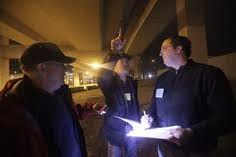
I remember the instructions we were given on the Annual Homeless Count in downtown Seattle. 

As we walked the cold, dark streets, at 3 in the morning, we were advised to bring a flashlight.  But this was only for us to see our way in the darkness.

Under no circumstances were we to shine the light on a sleeping homeless person. 

We were told the streets are their home and a light being shined on them in the darkness would be rude and disrespectful.
 

But we were to study their encampments, and quietly and respectfully discern how many people were living there.

This year’s One Night Count found 3,117 souls living outside of Seattle’s many homeless shelters.  Men, women and children of all ages.  

In Snohomish County, on the same night in late January, the annual Point In Time homeless count found 1312 homeless people, 41 more than last year. 

How a society takes care of the least of our sisters and brothers is a measure of being a light of the world, salt of the earth. 

The Prophet Isaiah spells this out in vivid detail:

“Share your bread with the hungry, shelter the oppressed and the homeless; clothe the naked… then light shall rise for you in the darkness.”

            Jim Withers is just such a light of the world.  His salt of the earth daily medical ministry is helping the homeless living on the streets of Pittsburgh, Pennsylvania.

            Since 1992, Dr. Jim Withers has made house calls to people with no houses.  He works five nights a week. 

            He believes that “unless you walk in someone else’s shoes, you don’t know what led them to have that life.”           

This street doctor with the easy smile, easy laugh and easy-going manner started his mission with a formerly homeless guy named Mike who works with Operation Safety Net, a ministry of Pittsburgh Mercy Health System.  Every night, Mike hands out sandwiches made by the Sisters of Mercy at their Motherhouse.

            Mike gave the doctor good advice when they started their   22-year mission together:  “Don’t dress like a doctor and don’t act like a jerk.”  He actually started out dressing like a homeless person to gain the confidence of those he treated nightly.

            Now he does everything from splinting fractured limbs, to treating cuts and bruises, to giving out cough and cold medicines, aspirin and Tylenol and even antibiotics to treat infection and pain.

            Today, Dr. Jim has medical students joining him nightly on his mission along with his friend Mike handing out sandwiches, blankets and other needed supplies.

            He’s treated 1,200 homeless people a year since starting his special street ministry.

            Dr. Jim confides, “people out there are hanging on for dear life.” 

He remembers vividly one of the first people he encountered in 1992. It was an 85-year-old homeless guy who was severely mentally ill.  His legs got so bad living on the streets that he would actually get maggots growing in his skin.

            Dr. Jim says “we have to stretch ourselves, and care enough to stretch ourselves into their world, into their reality.” 

            Dr. Jim says, “if you’re honest you see yourself in these street people.  You say, ‘I could have been there.  That could have been me.’”

He believes this model is a whole new way health care can be delivered to people in the greatest need in America and around the world. 

Dr. Jim is committed to seeing this model worldwide and has helped establish these street medicine programs in 85 cities around the world and on five continents through his program “NationSwell.”

He says he’d like to see “NationSwell” “become a point of pride, a jewel in the crown of communities everywhere.”

            Dr. Jim says, “we can to do this under one unified vision, that everybody matters.  That we need to look out for the people that are the most ostracized in our communities.  And that will make us a better people.”


Dr. Jim Withers is Christ among us.  He’s doing just what Jesus and the Prophet Isaiah say we all should be doing as the People of God.

            It’s not enough to just point to others and say, “isn’t that nice.”  If we do that, we are salt that’s lost its taste. 

No, each of us needs to commit ourselves to “not turn (our) back on our own.” 

            Dr. Jim Withers is also living out our Catholic Social Teaching in a beautiful way. 

Many in our Church say Catholic Social Teaching is our best kept secret in the world today.

            But our Catholic Social Teaching should not be a lamp hiding under a bushel basket.  It should “set on a lampstand where it gives light to all.”

            You may have noticed the banners hanging in the vestibules of both Churches listing the seven tenets of Catholic Social Teaching.  You’ll also find a copy in the bulletin in the week's ahead.

            The banners are there as a reminder of how we can be a light of the world and salt of the earth in our daily lives.

            The first tenet of our Catholic Social Teaching:   Life and Dignity of the Human person.  “The Catholic Church proclaims that human life is sacred and that dignity of the human person is the foundation of a moral vision for society.”

            Pope Emeritus Benedict XVI (the sixteenth) has written, “the protection of life in all its stages, from the first moment of conception until natural death is ‘not negotiable.’” 

            The fourth tenet of our Catholic Social Teaching:  Option for the Poor and Vulnerable.  “The Catholic Church teaches a basic moral test is how our most vulnerable members are faring.  In a society marred by deepening divisions between rich and poor, our Catholic tradition recalls the story of the Last Judgment (in Matthew’s Gospel) and instructs us to put the needs of the poor and vulnerable first.”

            This is an ancient, yet new teaching.  And it is the voice of God echoing through the millennia from the first reading from the Prophet Isaiah, to the responsorial Psalm, to the words of Jesus in Matthew’s Gospel, to Dr. Jim Wither’s poignant example today.

I would encourage you to study our Catholic Social Teaching. 

Know it.  Share it.  Live it.   

            It’s our Catholic lamp for being light of the world.

It’s a way for our light to shine before others, so “that they may see our good deeds and glorify our heavenly Father.”